
The Complete
UK Crypto Tax In 2025
Real Rules, Real Calculations, Real HMRC, Triggers
If you trade crypto in the UK, you already know something strange about this market. The wins never feel fully real until the tax bill lands, and the losses always feel more painful when you discover they still need reporting. Crypto has grown up, and so has HMRC’s approach to it. The days of thinking cryptocurrency sat in some tax-free bubble are long gone. In fact, 2025 has become the year where HMRC openly expects every crypto investor, casual or serious, to know how their transactions are taxed.
What makes this landscape tricky is not the rules themselves. It is that crypto behaviour is not the same as shares or property. A single month of trading can include hundreds of swaps, token migrations, moves between wallets, staking rewards, NFTs, losses by theft, and airdrops. Each one can create a tax event. And HMRC, for the first time in years, is proactively monitoring wallets, central exchanges, and on-chain activity through blockchain analytics tools.
This playbook brings clarity to a space filled with half-explained guidance. It draws from real UK rules, working examples, and the types of situations HMRC frequently investigates. Whether you are using a crypto tax calculator, working it out manually, or preparing for a conversation with a crypto tax accountant, this guide lays out the steps clearly.

Table of Contents
- Understanding the Foundation
- When Do You Pay Tax on Crypto in the UK
- The Annual Exemption Shrink and Why It Matters in 2025
- Exactly How Crypto Capital Gains Tax Works (Explained Without Jargon)
- Crypto Earned as Income: How It Is Taxed
- HMRC Crypto Tax Rules: How Far Their Reach Goes in 2025
- What a Crypto Disposal Actually Looks Like in Real Life
- Crypto Tax Calculator vs Manual Calculation
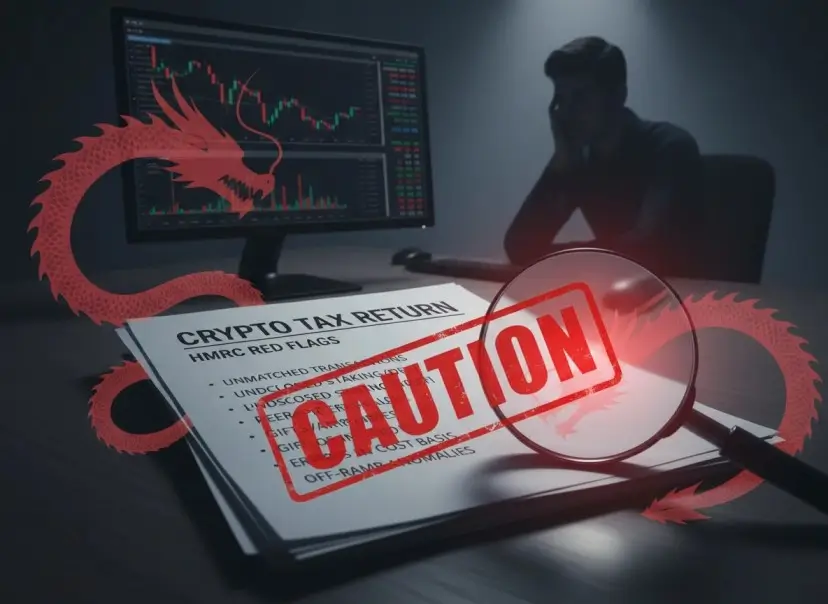
- Typical HMRC Red Flags in Crypto Tax Returns
- What Is the Tax Rate on Crypto Gains
- Tax Planning Strategies That Actually Work in Crypto
- The Future of UK Crypto Tax in 2025 and Beyond
- Final Thoughts: A Complex System That Needs a Structured Approach
Understanding the Foundation
Is Crypto Actually Taxed in the UK?
Crypto is treated neither as currency nor as gambling. HMRC views most activity the same way it views shares: as assets. And assets attract Capital Gains Tax when you dispose of them. But certain activities trigger Income Tax rather than CGT, especially where you are receiving crypto as a form of reward, payment, or yield.
Short answer: yes.
Here are the broad categories:
You have to pay capital gains tax.
● When you sell bitcoin for cash
● Change one currency for another
● Use crypto to buy things or services.
● Give crypto as a gift (unless to a spouse)
● Get cash out of an exchange
When you: Pay income tax.
● Get incentives for staking
● Get tokens by using DeFi protocols
● Get compensated in digital currency
● Get crypto by mining
● Get airdrops that you earned, not random ones.
● Get interest from lending platforms
This is the basic structure of crypto tax in the UK. But the true difficulty comes from keeping track of your cost base, figuring out your gains, and recognising when HMRC wants you to report something, even if you didn't put it in a bank account.
When Do You Pay Tax on Crypto in the UK
You do not pay tax when you buy crypto.
You do not pay tax when you move crypto between your own wallets.
You do not pay tax when the value rises while you hold it.
You pay tax when there is a disposal.
The biggest confusion in crypto tax is that people assume tax applies only when money hits a bank.
That has never been the case.
If you swap £10,000 worth of Ethereum into Solana, that is a “sale” of Ethereum and a “purchase” of Solana for tax purposes.
The gain on the Ethereum must be calculated instantly.
This is why HMRC is deeply interested in swaps, not just bank withdrawals.

The Annual Exemption Shrink and Why It Matters in 2025
One of the biggest tax shocks was the shrinking of the CGT allowance.
● In the 2022 period, the allowance was £12,300
● By April 2024, it fell to £3,000
● For 2025, it remains at £3,000 unless further reduced
This means thousands of investors who were previously outside the tax net are now instantly inside it.
If you sold or swapped crypto with gains over £3,000 in a tax year, you are required to file a Self Assessment return even if you have no other reason to file.
Exactly How Crypto Capital Gains Tax Works (Explained Without Jargon)
HMRC uses a cost basis method called share pooling.
This means you do not track every coin separately.
Instead, you track the average cost of your entire holding of each asset type.
Here is a simple example:
You buy 1 BTC at £20,000
You buy 1 BTC at £30,000
Your pool cost is £50,000 for 2 BTC
Average cost is £25,000 each
If you sell 0.5 BTC for £18,000:
● Allowable cost: £12,500
● Gain: £5,500
This gain contributes to your £3,000 allowance.
But what about buying and selling on the same day?
HMRC applies same day rules before pooling.
If you buy and sell the same asset within 24 hours, they are matched directly.
And the 30 day rule?
If you sell crypto and rebuy the same crypto within 30 days, the cost basis changes.
This rule prevents “bed and breakfasting” where people sold assets just to crystallise losses.
Crypto Earned as Income: How It Is Taxed
Staking, mining, yield, airdrops, and rewards often attract Income Tax first.
Later, when disposed, they also attract Capital Gains Tax based on market value at the time you received them.
This double layer catches many people off guard.
Example:
You earned staking rewards worth £1,200 over the year.
This is taxable as income.
Months later, the value rises to £1,900 and you sell.
Your CGT gain is £700.
HMRC Crypto Tax Rules: How Far Their Reach Goes in 2025
This is the part nobody likes hearing, but it matters.
HMRC has agreements with major exchanges including:
Binance
Coinbase
Kraken
Crypto dot com
Bitstamp
Plus many European platforms operating in the UK
These exchanges provide:
● Wallet identifiers
● Names
● Purchase and sale amounts
● Transaction histories
● Withdrawal destinations
In addition, HMRC now uses blockchain analytics that trace funds through chain hops, mixers, DEX platforms, wallets, and bridges. The assumption many traders used to make that “DeFi is invisible” is no longer accurate.
HMRC has also shown a rising interest in:
● Binance Smart Chain
● Solana
● Ethereum L2s
● Cross chain bridges
● NFT trades
If something is on-chain, HMRC can usually see it. Taxpayers are expected to disclose all disposals whether or not a KYC exchange was used.
What a Crypto Disposal Actually Looks Like in Real Life
People often misunderstand disposals because crypto behaviour is not linear. Here are real life situations that count:
Swapping coins on Uniswap
You have disposed of Asset A and acquired Asset B.
Taxable event.
Buying NFTs
You have disposed of your crypto to purchase a digital collectible.
Taxable event.
Moving coins between your own wallets
Not taxable, as long as you own both wallets.
Sending crypto as a gift
Taxable unless the recipient is your spouse.
Losing crypto due to exchange collapse
You might be able to claim a “negligible value claim”.
Tokens lost in a rug pull
Possible loss claim if the asset truly has negligible recoverable value.
Receiving free tokens randomly (true free airdrop)
Not income, but CGT applies on disposal.
The details matter because most crypto investors do all of these unknowingly.
Crypto Tax Calculator vs Manual Calculation
Which One Works in 2025
Crypto tax calculator tools are everywhere now. Some are decent for a simple portfolio. But the problem begins when the data includes:
● NFT trades
● DeFi protocols
● Token migrations
● Bridges
● Wrapped tokens
● Failed transactions with gas fees
● Lost coins
● Swaps on multiple chains
● Old exchanges that no longer exist
No UK crypto tax calculator perfectly handles these situations.
Most of them:
● Misclassify rewards
● Miss gas fees
● Treat transfers as disposals
● Duplicate transactions
● Apply wrong CGT rules
● Ignore 30 day matching
● Ignore same day matching
This is why HMRC warns that taxpayers remain responsible for the final figures even when using third party tools.
The safest approach is:
1 Use a calculator for an initial draft
2 Correct the errors manually
3 Review with a crypto tax accountant for accuracy
For large volume traders, manual review is not optional. HMRC knows where calculators go wrong and asks targeted questions during enquiries.
Typical HMRC Red Flags in Crypto Tax Returns
Patterns, not numbers, are what usually make HMRC ask questions. Here are some warning signs that are common:
1. Declaring zero crypto activity despite exchange data existing
If Coinbase or Binance has records of you trading and you declare no crypto activity, the risk becomes very high.
2. Only declaring bank withdrawals
HMRC expects disposals to be based on activity, not withdrawals.
3. Not telling about airdrops or staking rewards
A lot of investors forget that income tax applies here.
4. Using the wrong cost basis
Incorrect manual calculation is a major trigger.
5. Ignoring NFTs entirely
NFTs fall under CGT and HMRC knows who minted, bought, and sold them.
6. Large transfers between wallets with no explanation
If wallets are not matched to you, HMRC asks questions.
7. Reporting losses with no transaction evidence
Losses must be proven.
What Is the Tax Rate on Crypto Gains
This depends on your income.
Capital Gains Tax Rates (2025)
Businesses must:
● Basic rate taxpayer: 10 percent
● Higher and additional rate: 20 percent
Crypto is treated the same as shares for CGT purposes.
Income Tax on Crypto Income
This depends on total taxable income:
● 20 percent
● 40 percent
● 45 percent
Plus National Insurance depending on the scenario.
Tax Planning Strategies That Actually Work in Crypto
These are not loopholes.
These are legitimate HMRC-compliant approaches used by informed investors.
Use your annual CGT exemption
Even £3,000 helps reduce future tax bills.
Offset losses properly
Losses carried forward can reduce future gains for life.
Spouse transfers
Gifting crypto to a spouse is not a disposal.
You create a second CGT allowance and can split gains.
Time disposals before April deadlines
Sometimes selling a week earlier or later can save thousands.
Careful with 30 day rule
It can create higher tax than expected if you repurchase quickly.
The Future of UK Crypto Tax in 2025 and Beyond
Expect tighter reporting.
Expect real time integration with exchanges.
Expect HMRC to introduce centralised disclosure for crypto assets, similar to foreign bank reporting.
There is no landscape where crypto becomes tax free again.
Final Thoughts: A Complex System That Needs a Structured Approach
Which One Works in 2025
Crypto taxation can seem daunting, not because the rules are obscure, but because the volume of transactions becomes unmanageable for most people. The biggest challenge is not the law. It is bookkeeping. The tracking. The matching. The losses. The staking. The swaps. The small details that balloon into confusion.
If your portfolio has grown, shrunk, jumped chains, expanded into NFTs, moved across exchanges, or built staking income, the numbers become complicated quickly. This is exactly where professional guidance stops being optional.
For investors who want to avoid errors, protect themselves from HMRC enquiries, and make sure every allowance, loss, and relief is used correctly, tax specialists can save both time and money.
This is where firms like Taxaccolega, with long standing experience in crypto, capital gains, and HMRC compliance, support investors in preparing accurate calculations, filing correct returns, and keeping their tax position fully protected.